
Your Water Future at Stake
When I was a younger man living in Phoenix the old beards told me that we are “living on an ocean of water underground, and we won’t run out any time soon.”
The claim was false then and it most definitely is now.
The 1980 Groundwater Management Act had epic loopholes in it when it was passed, and legislators over the years have added more loopholes —pushed along by home developers and realtors.

But now enter data centers. AI data centers and the rush to build more water-wasting, polluting, gas-fired power plants to cater to them are super-charging our problem.
Data centers waste water when they demand more power from new gas power plants.
And some data centers waste water in a second way. If they allow water to evaporate after it pulls heat off of the data center’s banks of computers, that water is gone.
To be fair, some data centers re-chill their own water after cooling computers, in a closed loop system.
But the more they chill their own water, the more energy it takes to chill the water, the more power they demand from utilities and (at least with fossil fuels) the more water is used to chill the power plants.
Remember this term: the energy-water nexus. Be sure to use it to impress your friends with your knowledge of energy policy.
We use water to generate power, at least when it comes to fossil fuels.
Water is mined, not replenished
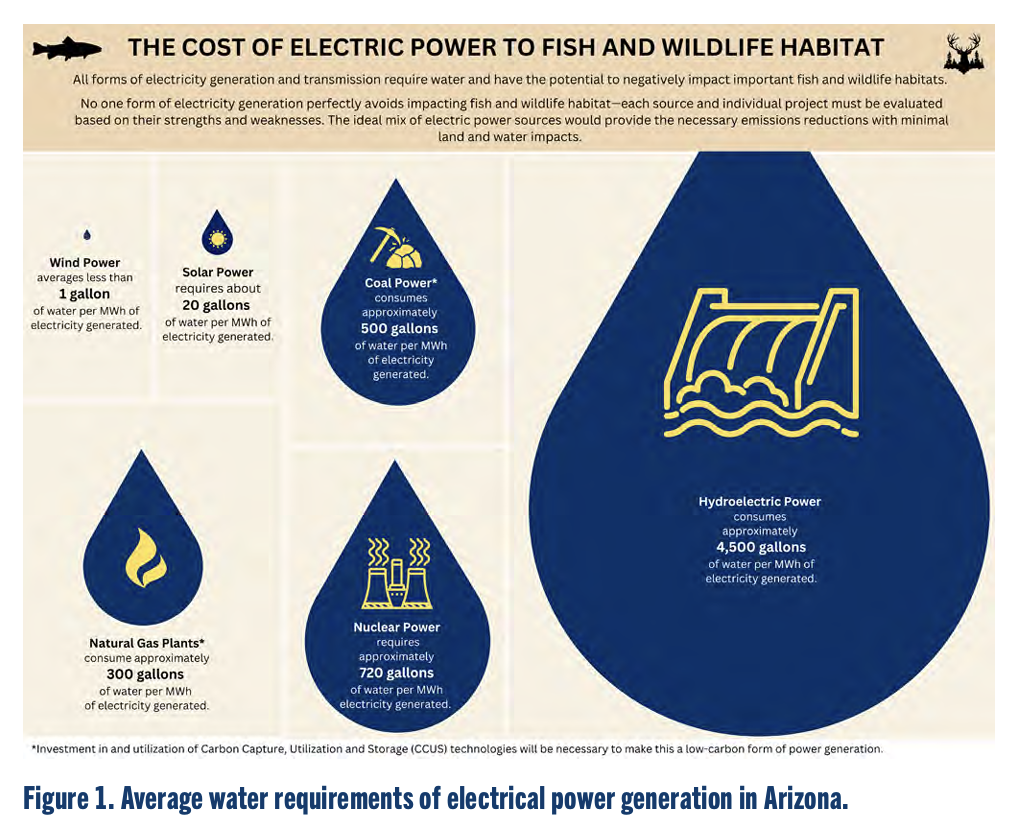
Rather than thinking creatively and focusing on reducing demand, our utilities, including the SRP board, are rushing to add more dirty power.
The utilities under current leadership don’t really take long-term water conservation in to account in a way that they should. There are very few disincentives to use lots of water today.
This means we are using up water for energy now and leaving future generations with the cost of adapting to inevitable scarcity.
So, how can we have our cake and eat it, too?
We need to to generate power that uses less water, pollutes less, does less harm to people and animals and costs less. There is only one type of energy that will deliver all of that, and will save money.
Having said that, I need to deliver some bad news —and I won’t sugar-coat it.
It will be nearly impossible to lower rates in the next few years. The pointless tariffs and the loss of clean energy tax credits have made rate increases a reality.
Any candidate who claims they will reduce energy costs in today’s conditions is lying to you.
But we can do a lot to slow that growth. As I explained in my Energy Liberty Substack article, we need to invest in slowing demand growth, rather than reflexively adding more dirty power plants.
It is a simple equation:
Demand Side Management
+
Customer-side Solar
+
Batteries
=
Cost Savings and Reliability.
What does this mean? Simply put, utilities can avoid new power plants by helping customers save money by investing in customer rebates for things like Energy Star appliances, more efficient heat pumps or insulation. For small, locally-owned businesses, they could help with energy efficiency measures that save them and the entire grid system money.
Similarly, utilities should help us get more solar and batteries on our homes and businesses.
I hear some misguided politicians saying, “Don’t make me pay for my neighbor’s new A/C.”
This is short sighted, and ignorant of real-world experience. Statements like these are designed to divide us against our neighbors. For decades we’ve known that every dollar devoted to energy efficient programs avoids multiple dollars thrown in to unnecessary and often dirty new power generation.
I also hear people saying, “People with solar are shifting costs on to those customers without solar.” This claim has been the justification to add massive fees on solar customers, and has just recently been debunked by the National Renewable Energy Lab (NREL).
That’s NREL of the Trump administration. Not Biden.
So, the more savings we build in to the customer side of the ledger, the less new power we have to build and…say it with me… the less water we need to mine from below our feet.